
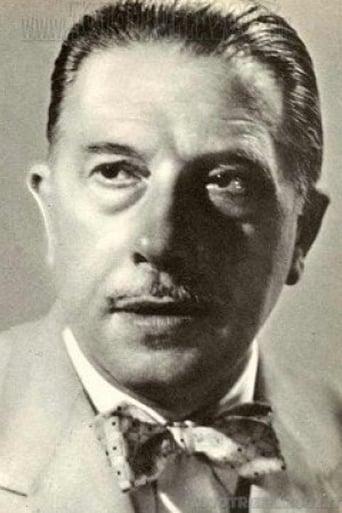

If Death Note was a middling Italian comedy.
We use cookies to personalize your experience and analyze traffic. You can opt out at any time.

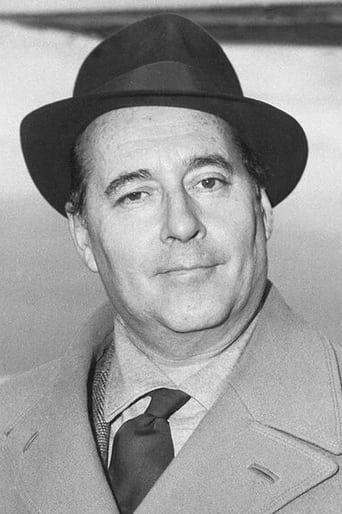
Σκηνοθεσία Roberto Rossellini
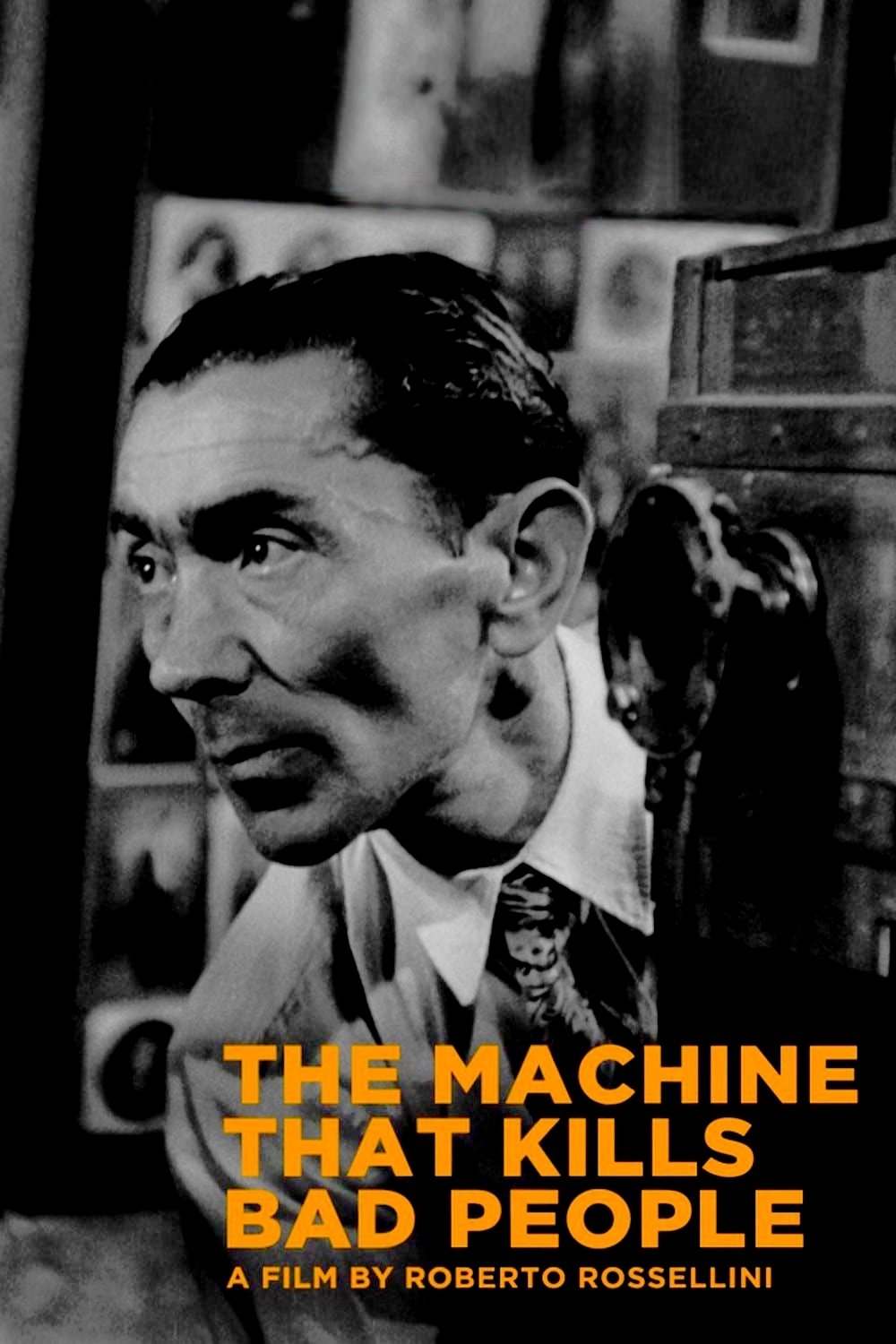
The Machine That Kills Bad People
Σε ένα χωριό της ακτής Αμάλφι, ένας ηλικιωμένος με υπερφυσικές ικανότητες χαρίζει στον ντόπιο φωτογράφο Τσελεστίνο Εσπόζιτο τη δύναμη να εξολοθρεύει τους κακούς ανθρώπους μέσα από τον φακό του.
Δεν υπάρχουν προβολές της «Η Μηχανή που Σκοτώνει τους Κακούς» στην πόλη Λος Άντζελες σήμερα.
Προβολές για Η Μηχανή που Σκοτώνει τους Κακούς, ενημερωμένες κάθε πρωί
Διάλεξε σινεμά και πάρε υπενθύμιση πριν κατέβει.


If Death Note was a middling Italian comedy.

The idiot died doing the fascist salute. We needed a special coffin

To some extent, I’ve been wrong about neorealism and need to rectify that with what I’m learning in Tag Gallagher’s extensive Rossellini biography, along with Peter Bondanella’s analysis on the filmmaker’s critical turning points. A lot of my research over the years, both during my undergrad and independent study, has leaned towards a very textbook definition of what neorealism is supposed to be about (unemployment, poverty, proletariat despair) and how it is supposed to achieve those ends (nonprofessional actors, documentary photography, authentic locations). Any simple Google search will parrot the same formulas (focus on a slice of postwar daily life, shoot in the streets, avoid dramatization) and outline the same politically correct goals (expose Fascism’s distortions, inspire social change). However, the more I study this movement and learn from its own filmmakers, the more I realize how convoluted the genre really is in terms of its content, politics, technique, approach, style, and attitude. Studying Rossellini has been eyeopening because I’m learning he’s not only the bridge between a lot of other major figures in the neorealist movement, he’s also the bridge into a very different form of neorealism that moves beyond the bombed-out postwar aesthetic and expectations.Originally, for example, I never cataloged Fellini or Antonioni as neorealist filmmakers because 1). their oeuvres are largely not preoccupied by socioeconomic problems, and 2). they rarely employ the documentary realism associated with the movement. One can look to early Fellini (NIGHTS OF CABIRIA, I VITELLONI, LA STRADA) and early Antonioni (IL GRIDO) as textbooks examples of what neorealism was supposed to be about and how it was supposed to look and feel, but once you move beyond the 1950s, you get films from both that are far more personal and expressionistic in nature, even surreal and abstract. In other words, the bulk of Fellini’s and Antonioni’s oeuvres do not conform to a single politically correct path of the genre — that of social realism. As a result, some have argued their late work isn’t neorealist at all (I myself have long been in this camp). Yet, looking at neorealism as a continuum rather than a fixed formula opens the doors to how these filmmakers viewed their own work, which is something I had previously taken for granted. Fellini believed that the postwar “Cinema of Reconstruction” had to move beyond social and economic problems. In 1960 he stated:“Remember, after the war our themes were ready-made. Primitive problems: how to survive, war, peace. These problems were topical, immediate, brutal. But today the problems are different. Surely the neorealists would not hope for the continuation of war and poverty just because it gave them good material…Instead of realizing that neorealism was a beginning, they assumed it was an end, a golden age. Some of the neorealists seem to think that they cannot make a film unless they have a man in old clothes in front of the camera. This is not right. We have not even scratched the surface of Italian life.”For Fellini, neorealism meant something more than its content; it was also a matter of style, personal vision, and perspective. He continues:“Why should people go to the movies, if films show reality through a very cold, objective eye? It would be much better just to walk around in the street. For me, neorealism means looking at reality with an honest eye — but any kind of reality: not just social reality, but also spiritual reality, metaphysical reality, anything man has inside him.”Antonioni, the master of elevating realism into the ephemeral and eternal, also viewed classical definitions of neorealism as a dead end. Instead of tackling the obvious socioeconomic challenges that cursed the postwar years, his work called for a more psychological experience — an examination of the spiritual malaise that accompanied the era of reconstruction, inspired no doubt by Rossellini’s STROMBOLI and other complex films he made with Ingrid Bergman during the 1950s. In 1963, Antonioni stated:“The neorealism of the postwar period, when reality itself was so searing and immediate, attracted attention to the relationship existing between the character and the surrounding reality. It was precisely this relationship which was important and which created an appropriate cinema. Now, however, when for better or worse reality has been normalized once again, it seems to me more interesting to examine what remains in the characters from their past experiences. This is why it no longer seems important to make a film about a man who has had his bicycle stolen…it is more important to see what there is in the mind who has had his bicycle stolen, how he has adapted himself, what remains of him of his past experiences, of the war, of the period after the war, of everything that has happened to him in our country.”The “normalized” cinema in which Antonioni speaks is the single definition of neorealism that soon became a formula in Italy. The trend was to make films about postwar hunger, injustice, unemployment, poverty, prostitution, proletariat despair, drug addiction, abuse of orphans, etc.. Italian filmmakers were growing tired of such definitions prescribed by the ideologues. Eventually, says Gallagher, “there was no point in making films if they all had to follow the same formula, that people had been led around by their noses for years by Fascism, and that now it was time to reject all that and find a fresh way to say new things.” This statement is both ironic and progressive: the neorealism of ruins and socioeconomics was a progressive formula meant to expose the lies under Fascism, just as the emotional neorealism of Rossellini’s collaboration with Bergman, or Fellini’s journey into surrealism, or Antonioni’s dive into spiritual ruin, was an expansion of the genre beyond physical ruins and socioeconomic hardship. From Rossellini’s perspective, “The essence of neorealism was its moral attitude: to be as honest as possible.”This has been a really long build up to contest a simple point: Neorealism, for Rossellini, Fellini and Antonioni, was not simply about shooting ruins, utilizing newsreel techniques, or reaching verisimilitude with war-torn reality. Neorealism included these elements and aesthetics, but moved far beyond them to embrace spiritual reality and metaphysical reality. And it was Rossellini, I believe, who inspired their journeymen-to-auteur paths, first with films like STROMBOLI, second with films like THE MACHINE THAT KILLS BAD PEOPLE, and third with the films he made during the Ingrid Bergman era. THE MACHINE THAT KILLS BAD PEOPLE is a very strange and somewhat anachronistic film for Rossellini to make. It’s almost guaranteed to give anyone whiplash who’s watched his work chronologically. Rather than immersing itself in classical neorealist mythology, it satirizes the genre through a very fictitious, artificial plot, arguing in effect that the line between neorealism and surrealism is not very far apart at all. The plot is shamelessly convoluted to a fault, but the premise sticks in a way that supports a very important transition both for Rossellini’s career, and for neorealism generally. A devil disguised as a saint gives a local town photographer a magical camera that can kill whoever it photographs, but the workings are intricate. The magic only works if the photographer takes a photograph of a photograph of the person he wants to wipe away, thus enabling him with a self-righteous power to eliminate his enemies. Celestino believes he’s been endowed with the ability to penetrate bedrock reality through photographic images, but he’s actually “two steps removed from the world of tangible phenomena,” says Bondanella, “and is engaged in the essentially self-reflexive act of producing a work of art from another work of art, not directly producing art from reality.” Such Platonist foolery turns Celestino into a neorealist purist of Rossellini’s time, tricking him into believing he can separate “reality from illusion, good from evil, substance from appearance.” If you’re not sensing the satire here, this is the auteur’s humorous critique on neorealist mythology and the idea that the camera gives us pure, unmediated access to reality. The symbolic importance of what Rossellini is saying about photography and cinema as an art form is an affront to those neorealist purists of the 1940s variety. While shooting on location, using nonprofessional actors, and employing documentary techniques might bring a film closer to what Bazin referred to as “naked reality,” the neorealists never simply “photographed” the reality surrounding them. Like Celestino, they reconstructed, as opposed to captured, reality. They created, as opposed to discovered, reality. The very act of photography implies manipulation on some level, which led Bazin to paradoxically conclude that “realism in art can only be achieved in one way — through artifice.” Though Lars von Trier’s Dogme 95 troupe would disagree with Bazin, we’ve seen Rossellini’s career already engage with artifice on some level: ROME OPEN CITY employs a very crude, melodramatic style within a gritty newsreel-style realism to showcase why good must defeat evil; PAISAN’s episode “Rome” juxtaposes melodramatic flair within the tragedy of a communication breakdown; the over-the-top performance of Anna Magnani in L’AMORE is far more theatrical than realistic; and the swelling strings of Edmund’s death in GERMANY YEAR ZERO signals an intense emotional response, often associated with melodrama. The point is simple. Neorealism has often been touted as the escape from “artifice” and the window into “reality,” but what Rossellini’s own films have shown us is there isn’t always a sharp distinction between fiction and fact, realism and surrealism, reportage and flourish. Even his purest attempts at the genre have small schematic moments of showcasing either melodrama, comic amplification, or brooding psychological workings. Such instances might seem beneath the ideologues who wanted him to remain a pure avant-garde artist, but for Rossellini, realism owes no apology to artifice if the perspective is morally and/or spiritually honest. For Rossellini, realism was quite simply “the artistic form of the truth,” a brand that Fellini and Antonioni would take far beyond the auteur’s experimentations. In truth, Rossellini’s break from neorealist formulas signaled his dissatisfaction with neorealism construed as a matter of pure socioeconomic concern. In considering the next evolution of how his brand of “neo” would expand his “realism,” one needs only watch STROMBOLI, THE MACHINE THAT KILLS BAD PEOPLE, or any other film from the Bergman era.In consideration of the filmmaker’s own words on the matter, Rossellini stated:“The type of realism that I inaugurated with Roma città aperta and Paisà is no longer of any use today….Today other things concern me. Today I think one must discover a new and solid base for constructing and for representing man as he is, in the marriage that exists in him between poetry and reality, desire and action, dream and life. For this reason I made L’amore and La macchina ammazzacattivi, which is perhaps my most original film…One is moved to take up other themes; interest is shifted somewhere else, you have to take other paths; you cannot go on shooting ruined cities forever. Too often we make the mistake of letting ourselves be hypnotized by a particular milieu, by the feel of a particular time. But life has changed, the war is over, the cities have been rebuilt. It was the story of reconstruction that had to be told.”Rossellini’s brand of Cinematic Reconstruction explains a lot about my shortsightedness with the genre despite studying it for years. It explains the power of canon completion and viewing a movement in context, rather than in isolation. It also explains a lot about the kind of inspiration that fueled Fellini’s and Antonioni’s careers. While not classically neorealist from a 1940s perspective, there’s an argument to be made that these filmmakers evolved the “neo” in neorealism beyond a fixed cinematic style and specific brand of thematic content. Realism, for all three filmmakers, embraced all kinds of reality — spiritual, psychological, fictional — not just social or historical. For these reasons, Bondanella has stated:“La Macchina ammazzacattivi thus occupies a very important place in Rossellini’s cinema…Its value lies in the fact that it helps to explain the transition from Rossellini’s war trilogy to a very different kind of cinema altogether…It would be a mistake to equate the artistic merits of the film to those of Rossellini’s greatest works. But it would also be critically incorrect to ignore the film, as so many critics of Rossellini have done in the past. A flawed, imperfect work, it nevertheless serves as testimony to the transition taking place in Rossellini’s career from neorealism to an entirely different kind of cinema that would find its most felicitous expression in his work with Ingrid Bergman.”Rossellini Ranked
A photographer in an Amalfi village receives a magical ability to kill local evildoers simply by photographing them.
Roberto Rossellini directed the film in 1952, a noted Italian filmmaker famous for pioneering the neorealist movement.
Yes, it is a satirical fantasy-comedy that blends the conventions of post-war Italian neorealism with a moralistic fable.