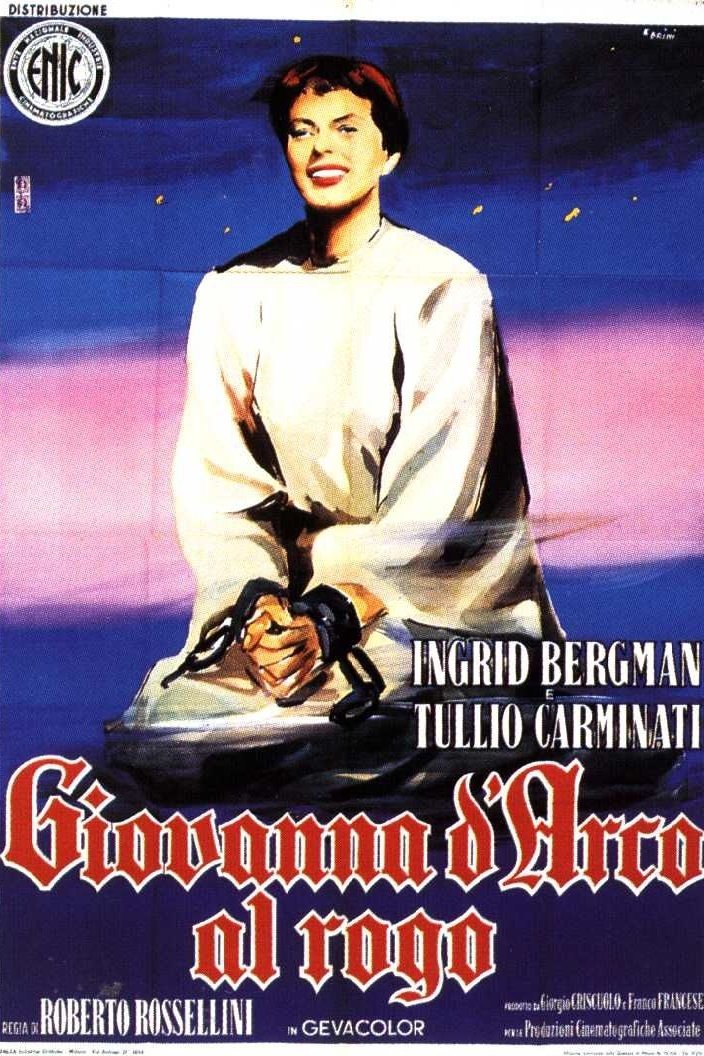



Part 7 of the May Film ChallengeSixth Roberto Rossellini (after Journey to Italy, Rome, Open City; Beaubourg, Fear and The Taking of Power by Louis XIV)One of Rossellini’s most deranged looking films, as visually removed as possible from the location shooting of Rome, Open City, that often loved bastion of Neo-Realism. But as someone has noted here, Rossellini in the 1950s was apparently interested in depicting inner psychology in a Realist manner and that you can see this film as an expression of Joan’s hyper-sensitised mindset on the eave of her burning.* Certainly, this is a productive way to view this film, both in the wider arc of Rossellini’s career and what has been said about Joan’s capacity for visions as stemming from mental difference, namely (possibly) epilepsy. It’s filled with violent colour, almost like a Méliès phantasmagoria in its bright blues and reds to give an incredible sense of the heightened sensorial world Joan inhabits, a moment of tremendous delirium in the face of annihilation. Even though it’s only one set, there’s some brilliant pieces of stage business involving a cutaway through a wall to a ballet of provincial French life, a completely delirious moment that ties in with the idea of her visions as projections of her own psyche, an image that cheats perspective in its interiority. It resembles one of the medieval Passion Plays in its aesthetics, and certainly the emphasis on the suffering experienced by Joan being redeemed by her faith and devotion suggests as much. It’s an exhausting work, even at just over an hour, largely thanks to Honegger’s brilliant but intense music and the faintly absurd oratorio (presenting Joan’s trial as a series of animals is…a choice), but it’s tinged with the greatness that marks much of Rossellini’s work.*Here1. Journey to Italy2. Fear3. Joan of Arc at the Stake4. The Taking of Power by Louis XIV5. Rome, Open City6. Beaubourg