

oh, the limitations of thinking we know ourselves & the startling realization that someone else can know us better
We use cookies to personalize your experience and analyze traffic. You can opt out at any time.

Directed by Éric Rohmer
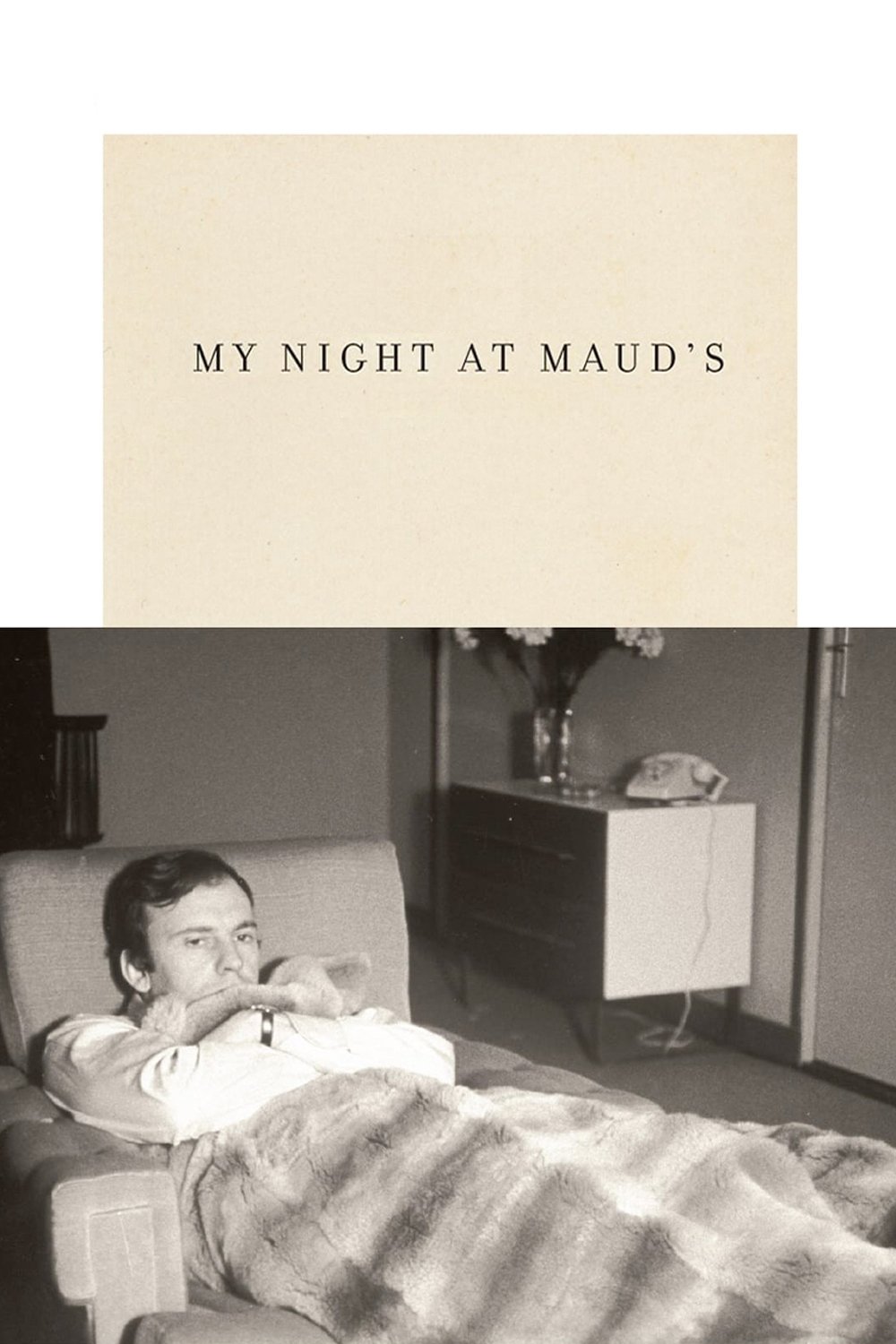
Ma nuit chez Maud
An acclaimed, intricate romance.
The Catholic Jean-Louis runs into an old friend, the Marxist Vidal, in Clermont-Ferrand around Christmas. Vidal introduces Jean-Louis to the modestly libertine, recently divorced Maud and the three engage in conversation on religion, atheism, love, morality and Blaise Pascal's life and writings on philosophy, faith and mathematics. Jean-Louis ends up spending a night at Maud's. Jean-Louis' Catholic views on marriage, fidelity and obligation make his situation a dilemma, as he has already, at the very beginning of the film, proclaimed his love for a young woman whom, however, he has never yet spoken to.
My Night at Maud's isn't screening in cinemas right now.
Follow the film in the app to get notified when showtimes are added.
My Night at Maud's showtimes, refreshed every morning
Pick your cinema, get a nudge before it leaves screens.


oh, the limitations of thinking we know ourselves & the startling realization that someone else can know us better

“The thought of the future needn’t depress us, since we have none.”Éric Rohmer’s third of his six moral tales, My Night at Maud’s, concerns a Catholic man, Jean-Louis, who lives life practising a philosophy based on rationalisation and mathematical probability. At church, he falls in love with a beautiful young girl and vows she will be his wife. She is his ideal partner: blonde, pure, and devout. But after a brief encounter with an old schoolmate, Jean-Louis finds himself precariously spending a night with the enigmatic and provocative Maud, a free-spirited divorcée whose bewildering charm and complexity threaten to dismantle his rigid moral principles and standards.Rohmer is known for his modern and liberal approach to social and gender relations; there is a sense of irreverence and maturity to the manner his characters discuss sex, desire, and other cultural taboos. Both Jean-Louis and Maud are unassumingly confident and articulate, in equal measure capable of deception and self-deception. Each assertively proclaims their philosophy on life seemingly less to convince the other, but more to convince themselves, a cognitive process that blinds them to the true nature of their moral engagements.Unlike his Cahiers du Cinéma contemporaries of the Nouvelle Vague, Rohmer’s style is comparatively modest and rarely calls attention to itself, favouring instead to maintain a delicate balance between realism and theatricality, between intellect and melodrama. Concentrating on the lives of everyday people and their tendencies and temptations, Rohmer's films are a brand of affecting humanist cinema, of eroticism through language. His thoughtful and sensitive writing reveals a deep understanding and compassion of the human condition. My Night at Maud’s, perhaps Rohmer's best and most accessible work, is a profoundly captivating study on the messiness and contradictions of moral ideals and religious conviction.

talking smart and trying to fuck, the rohmer way
The film follows a Catholic engineer who becomes involved in a deep philosophical debate about love, probability, and religious morality during a chance winter encounter with an old friend and a captivating woman.
The film was directed by French New Wave auteur Éric Rohmer, released in 1969 as the third entry in his six moral tales series.
It received nominations for the Academy Award for Best Foreign Language Film and Best Original Screenplay.