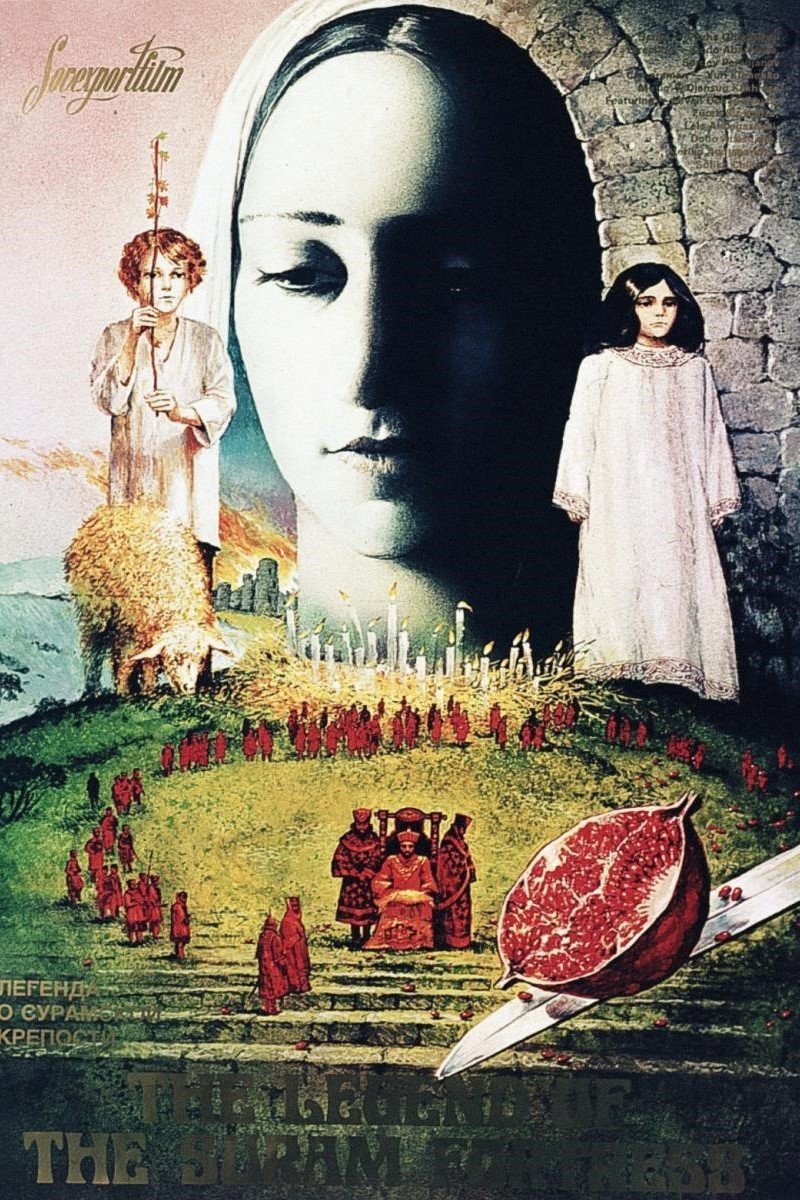


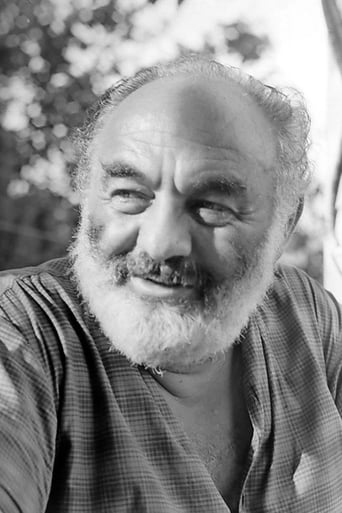


As is often the case, artists are punished for making their greatest masterpieces. That was the fate of Sergei Parajanov when he made The Color of Pomegranates. He was not allowed to make another film and put in prison (on charge of homosexuality) to silence him. He would be imprisoned 3 times in his life, one of the main reasons why he died of ill health. Color of Pomegranates was published in 1968 and it was not until 1986 (18 years later) that the world got to see a new film from the master. And what does he film? A story about immurement. Was there a hidden message in this topic? I think so.Immurement is a motive found in so many legends. Albania has The Legend of Rozafat Castle, about a woman who is bricked up inside a wall to make it stronger /her breast is left outside so she can feed her child). Georgians have this, The Legend of Suram Fortress about a man immured inside a wall to make a fortress stronger. And similar stories are found through out all of Europe. What is even more amazing is that skeletons have actually been found inside walls. So this is not just a symbolic story but a testament of a terrifying sacrifice found all through Europe. It's easy to see why the communist party thought this was a good and safe topic for Parajanov. Imprison and sacrifice someone to make a country safe? Well, they did that all of the time. This could even been taken as a "thank you and I forgive you" statement from Parajanov. His acceptance of his imprisonment. Well it might be so if the story in the film did not hint at hidden motives. There are some spoilers here.Durmishkhan is in love with Vardo and wants to marry her. He is given freedom but she has to stay behind. He promises to come back for her but fails to keep his promise. Durmishkhan marries another woman and has a son with her. His name is Zurab. Vardo becomes a fortune teller. She finds out what really happens and it is she who suggests that the only way to safe the Suram Fortress is to immure someone who looks just like Zurab inside the walls of the fortress. Zurab ends by doing it himself and thereby saving the fortress. End of spoilers.It's Vardo's motive that hints at a hidden message in all of this, and the fact that this is all being done to help an evil prince to keep his power. The film can be read as Parajanov take on the lie within the Soviet system. They are told that sacrifices are needed to keep USSR safe but these sacrifices are just made to help a corrupt government to keep control and power. The film is visually breathtaking. Beautiful does not begin to describe it. It is poetic and other wordily. The style is perfect for a folk story/fairy tale. A lot of the imagery comes from icons and Muslim paintings, with almost two dimensional imagery where things are arranged from top to bottom (like on a A4 paper) instead of from close up to far away (like in most films). No one but Parajanov could have made this film and sadly no one will ever dare to make films like he did. A must see!