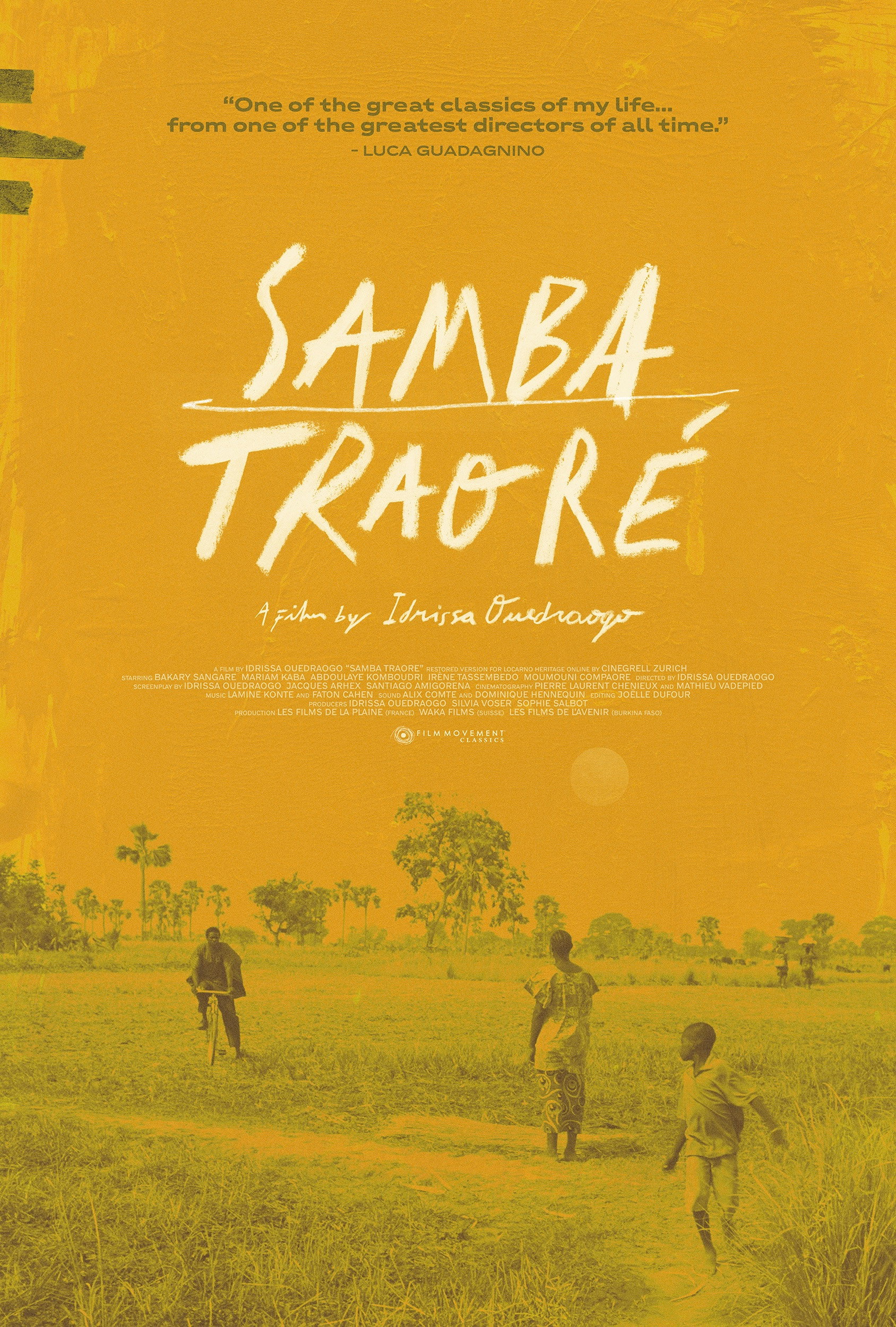
Idrissa Ouedraogo moral thriller, more crime and history than crime and punishment. Samba constructs a life in the village as he and we wait for the moment his actions will caught with him, but Ouedraogo isn't interested in a character study or psychology, but in description of Samba's, his new life, his village, actions have weight but it is the weight of responsability for what is still to come. Remarkable.
The richness of detail in Ouedraogo's images never stops overwhelming me; they are always so full of life, its sounds, movement, colors and light. A seemingly simply story like this turns into such a beautiful film quite easily when the filmmakers achieve the balance between their characters and their environment, the way they should be portrayed and in which relation in each particular case. I'm not sure what I can make of the commentary on play here but there's this peculiar human atmosphere that prioritizes the everyday life, its complexes and moments of beauty. This film is full of incredible moments of something realer than one usually sees on the screen, even something realer than one experiences in the moment in their lives...? Perhaps only cinema can offer an authentic glimpse of the present, with little manipulation nothing seems like manipulation at all; characters become even realer, richer. There always must be something that makes them move though, something that makes them tremble in the way that we become more aware of who they are. Sembène has simply said in response to ethnography, "[...] it is not enough to say that a man we see is walking, we must know where he comes from, where he is going." I find that many times especially us western viewers are baffled at the pacing of African films (myself included), how stripped some filmmakers can be. But I think, at least to some extent, that we have responsibility as viewers and human beings, to get rid of some of our aesthetic ideologies and simply look and listen. Cinema as nothing more than entertainment and industrial pleasure is poisonous because it teaches us wrong models to which we mirror everything. It's perfectly possible to make a film about human beings who do not explain their every intention and every problem that troubles their hearts, one doesn't need to show a beginning and an ending, or a relationships that follow certain patterns to fulfillment or disappointment. Samba Traoré already destroys each of these patterns; the film starts as if in the middle, every few words these people speak reveal what they are feeling without explanations or without even getting to the point of their problems, and the relationships of the film are in the state of constant movement with their undertone nevertheless coming clear even if we might not end up satisfied. You learn about the heartbeats of these people through the aforementioned richness in imagery, the close-ups of human faces, the way situations unpack and condense, the way everything simply is in relation to each other. The poetry is in the harmony of expression.There's a scene in which Saratou, the wife of Samba is being taken to the hospital to the town where Samba committed his crime because she is in labor. Samba decides not to return to the town at any cost and so Saratou is left with few other villagers like Samba's friend Salif. They manage to get a truck to lift them to the town but in the middle of it all Saratou finally gives birth and they stop the truck in the middle of the journey. When women of the village are helping Saratou to give birth, Salif walks further away to the driver and strikes up a conversation. They talk about children, Salif being childless (so far) while the driver has ten children and must work hard. The weight of this short conversation is quite heavy yet it takes only few words. And then we suddenly hear child's cry and the both stop their talk and smile brightly. It is a scene that has to be seen to be believed. One short moment that carries whole wide range of human emotion; from toughness of life to the insurmountable beauty of it. Life is to be lived for.Ouedraogo for me has opened a new way to see cinema and once again has made me believe in its endless possibilities. For me nothing gives more pleasure than a film one can write endlessly about yet it is something that only through viewing can be experienced in its fullest. God bless Ouedraogo where ever he is now.
1st Idrissa OuedraogoA film, as many have said here, less interested in the moral drama of a bankrobber returning home and more in the ramifications of his presence. That's not to say that people aren't interested in where his sudden wealth comes from, rather that it's of secondary importance to what his charismatic presence does to his home village. It feels miles away from noirish anguish in a manner I'm not adverse to at all, especially when the film encapsulates an ambiguous joy in Samba's presence and impact (wedding! wife's kid has a dad! new house!) tempered by the fact that it comes from extremely ill-gotten gains. The film also looks fantastic in a way that many African films do, brightly coloured and enlivened by joyous music. It's beautiful stuff, a reminder that I need to see more from Burkina Faso, Mali and Sub-Saharan Africa. I'm very much lacking in that area.