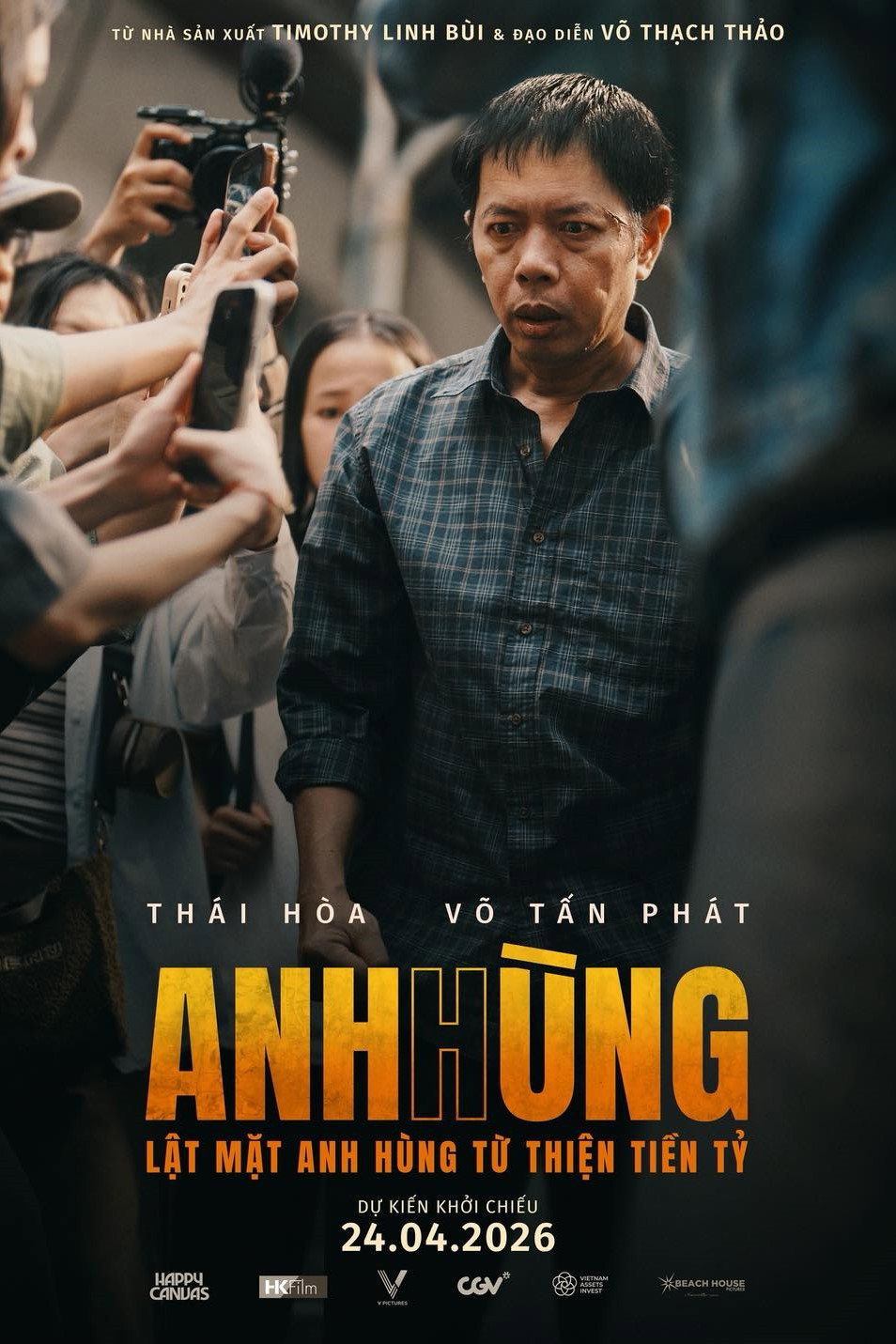
chị Thạch Thảo với bộ phim đầu tay khiến tôi rất bất ngờ vì edit gọn gàng quá, nhịp phim ok quá, các chi tiết có tính thời sự và phản ánh xã hội tốt đấy chứ? nếu phim đầu tay của đạo diễn Việt Nam nào cũng ổn như vậy thì ok mà. nhất là trong bối cảnh người xem bắt đầu có vẻ bội thực bởi phim kinh dị, phim hài, phim tình cảm... người xem cần được hấp thụ những bữa ăn mới có tính chất phản tư một xíu. tôi cứ ngỡ phim sẽ lê thê, hoặc xử lý yếu ở phần nào đó... nhưng hoá ra là chẳng có phần nào... thôi thì cũng được mà?
THE TEST OF HUMANITYAnh Hùng is my favorite among the five Vietnamese films currently in theaters this holiday season.Despite some unevenness in its plot and visual execution (which I will address later), it stands out as a rare local production that engages meaningfully with issues deeply rooted in contemporary social reality. In particular, it examines the figure of the “public hero” and the volatile culture of idolizing - and subsequently dismantling - individuals in an era where social media accelerates fame at an unprecedented pace, turning intrinsic values into performative acts and instruments of emotional manipulation for an audience constantly craving drama.The film’s premise is not entirely new. It inevitably recalls Hero (also known as Accidental Hero, 1992), in which Dustin Hoffman plays an ordinary petty criminal who, by chance, rescues survivors from a plane crash - only to exploit the situation for personal gain before disappearing into anonymity. The media, eager for a compelling narrative, constructs the myth of an “accidental hero,” while another man, played by Andy Garcia, inadvertently assumes that role and reaps both public adoration and financial reward.Anh Hùng appears to draw inspiration from this narrative framework, while also resonating with a real-life Vietnamese incident that once captured widespread public attention. Five years ago, a taxi driver named Nguyễn Ngọc Mạnh became an overnight hero after rescuing a child who had fallen from the 13th floor, miraculously saving her life. What began as a genuinely moving story of courage gradually evolved into something more complex: public praise escalated into calls for monetary rewards, media amplification intensified scrutiny, and the narrative itself became subject to dissection and judgment.In many ways, Anh Hùng imagines a more extreme version of this phenomenon. Director and screenwriter Võ Thạch Thảo transforms these influences into a distinct premise of her own: what happens when an “accidental hero” narrative is deliberately fabricated or exploited for personal gain - particularly within a social media ecosystem that can elevate someone to iconic status one day, only to dismantle them the next?The film unfolds at a measured pace, but demonstrates confidence in its early stages through careful world-building and nuanced character construction - a strength that likely stems from the director’s background in long-form television storytelling. Notably, it is one of the rare Vietnamese dramas in which characters feel like fully realized individuals rather than extensions of performance.Thái Hòa delivers a standout performance in a role that functions as a true titular character - one that seems almost tailor-made for him. He portrays a weathered, disillusioned man shaped by hardship: selfish and morally compromised, yet ultimately driven by a deeply human instinct to protect his family. Through restrained emotional expression and precise physical control - particularly in his eyes and facial tension - Thái Hòa captures the character’s internal contradictions with remarkable subtlety.The supporting cast is equally well-served by the screenplay, each given sufficient space to develop distinct psychological dimensions. Veteran actors such as Lê Thiện and Hồng Ánh bring gravitas, while younger performers including Võ Tấn Phát and Đoàn Thế Vinh contribute fresh energy. The child actor Gia Tuệ, as Bé My, delivers a particularly affecting performance marked by an unforced sense of innocence.Certain character dynamics - such as the grandmother-grandchild relationship - may evoke comparisons to films like How to Make Millions Before Grandma Dies, yet they remain distinctly rooted in Vietnamese cultural values, where familial sacrifice and compassion continue to hold significant weight.As noted earlier, however, the film’s strengths in setup and characterization are not fully matched by its resolution. The narrative surrounding the exposure of the fabricated “charity hero” lacks the sharpness and complexity that such a contemporary subject demands. The ending, in particular, feels somewhat restrained - even overly gentle - for a film that engages with such a volatile and morally ambiguous theme.Returning to the title of this essay - The Test of Humanity - Anh Hùng ultimately raises two interrelated questions within the context of a media landscape increasingly capable of shaping and manipulating collective emotion.First, the film does not simply ask who is good and who is evil. Instead, it poses a more unsettling question: what happens when morality ceases to be a personal choice and becomes a role performed before the public?Second, and perhaps more crucially, the film quietly shifts the focus of scrutiny. The true subject under examination is not the so-called “hero,” but us - the crowd that yearns to create icons to admire, only to be the first to tear them down when those icons inevitably fracture.In that sense, the “test of humanity” presented by Anh Hùng is not directed at any single individual. It is a test of society itself - a society in which morality is no longer an intrinsic value, but something that can be constructed, manipulated, and consumed like any other form of content.